|
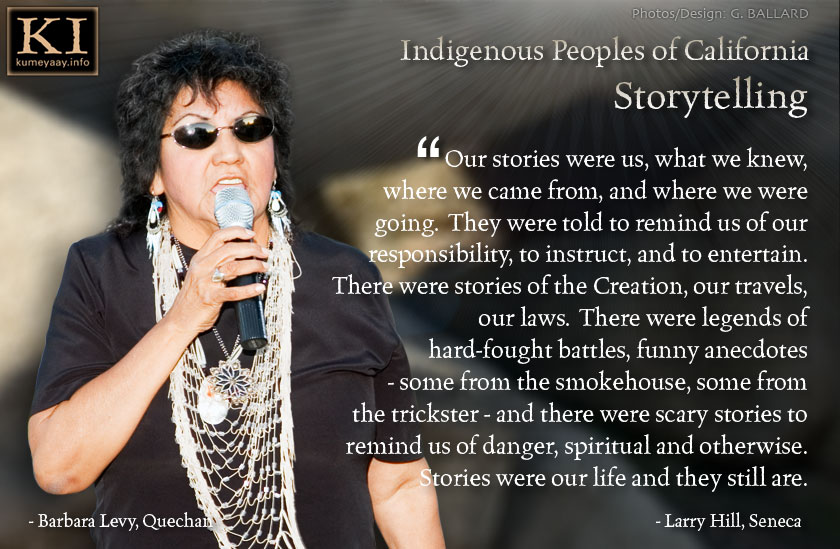
Barbara Levy, Quechan storyteller (pictured) — Larry Hill, Seneca stoyteller (quoted). Pictured in rollover: Able Silvas as Running Grunion.
STORIES OF AMERICAN INDIANS
YUMAN STORY PLAYING IN BACKGROUND:
Barbara Levy, a professional Quechan tribal storyteller was pictured above and recorded Shumup Ko Hup 4th Annual Fiesta in Old town San Diego State Historic Park November 19-20, 2005 for this Indigenous story-teller section. To listen to her story you will need to click on PLAY AUDIO:
UPDATED 2021 for Quicktime Bug
 PLAY AUDIO .m4a PLAY AUDIO .m4a
Haga clic para reproducir el audio
|
FEATURING:
Kumeyaay stories of the Brown-Curo family of Barona and Viejas.

Sam's kumeyaay.org site disappeared around October of 2005
Forward by Samuel Brown aka "Howka Sam" of Viejas, Kumeyaay:
FOR THOUSANDS OF YEARS, grandparent, parent and peer storytelling was a part of the Kumeyaay culture where family traditions and morals were passed along by such stories, and many others were told simply for entertainment and humor.
There were designated storytellers, who, for a price, would travel the countryside and enthrall inter-tribal audiences for hours telling stories of heroes, adventure, and mystery.
Now only fragments of the stories exist, and with fading memories this history is rapidly passing. It is the goal of these sites to preserve as much as possible of what remains.
This is an open invitation for any Kumeyaay members to send whatever stories and photographs they have for preservation on these web sites. The stories do not have to be great epics, they can be simple short paragraphs about events in the recent past that offer insight into the culture as it existed only a few years ago.
• We can scan your priceless original photographs at your home, and digitally restore them.
• We can photograph your priceless original items at your home, caption and catalog them.
• We can interview, video tape, and record your oral history, your stories, at your home.
Thank you for your interest.
SAMUEL BROWN
WEBMASTER: www.kumeyaay.org
Examples of such stories can be found HERE: 
These particular Kumeyaay stories are from the Brown-Curo family of Barona and Viejas - Howka Sam (Viejas) site expired 2025
|
|
ORPHAN BOY, recorded in 1960s by Mary L. LaChappa
Kumeyaay story in Kumeyaay language by Mary L. LaChappa in the 1960s, "Orphan Boy" by Native speaker.
UPDATED 2021 for Quicktime Bug
PLAY AUDIO .m4a
Haga clic para reproducir el audio
Kumeyaay recording contributed by Daleane Adams (digitally restored by G BALLARD).

KUMEYAAY STORY TRANSLATED into English The Rabbit Versus the Rattlesnake -- how the Kumeyaay language appears in writing.

THE KUMEYAAY SINGERS
a culture of oral storytelling through Song
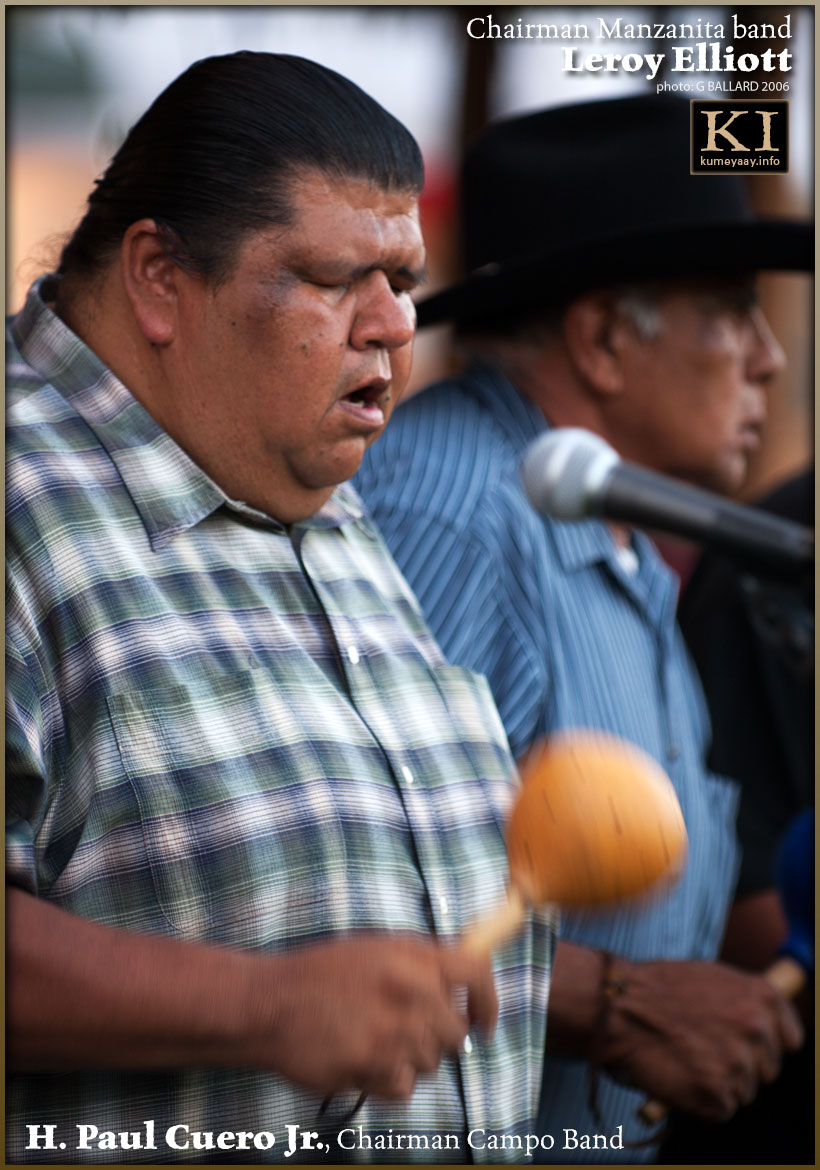
Harry Paul Cuero Junior (Campo Band of Mission Indians) pictured playing a gourd rattle and singing cultural stories alongside fellow Kumeyaay chairman Leroy Elliott (Manzanita Band of the Kumeyaay Nation) during a 2006 Sycuan gathering on the East County reservation.
Paul radiated a deeply spiritual aura -- most people who were blessed with his presence respected that.
Bird Singing Lore:
 We don't even know the meaning of some of our bird songs anymore because they are in an old, old language. But we know it's all a story that has been passed down from generation to generation. We don't even know the meaning of some of our bird songs anymore because they are in an old, old language. But we know it's all a story that has been passed down from generation to generation.
- Paul Cuero Jr. (1964-2025), Campo Band
Bird singing includes 300 songs that were given to the Kumeyaay from the Creator. Men and women sing them in our language, but only men accompany the singing with rattle playing.
The songs tell a story about Creation and a journey our ancestors made. The first song is about the sun going down, and it is sung at sundown. The singing continues until three o'clock in the afternoon the next day.
The songs are metaphors for life. There are teachings in them. It is like taking a journey through life and relating those experiences to today.
- -Campo Kumeyaay Curators, 2003
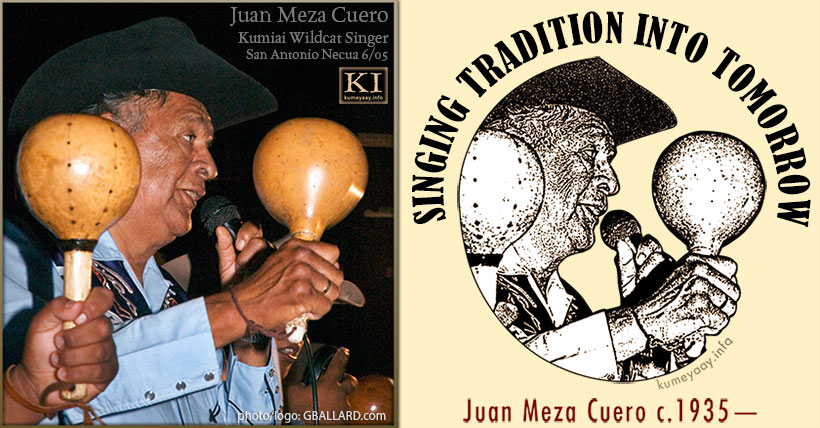
Juan Meza Cuero, Kumiai:
My style of singing is called Wildcat; in the Indigenous language it is called *nemi*. Even though we are Kumiai, we play differently. That is why they call me. This song can be played anywhere. Speaking of *Kuri Kuri*, it means, in my language, that there was an Indigenous man who sang a song that lasted a long time, and the dancers would say *Kuri Kuri*, which means, "Another, another!" Not the same one—change it, *kuakur kuakur*, as the words change. Depending on where they go, they call the celebration something different. Everyone has a nickname.
I have many songs, 120-something songs... This is a story from here, from the countryside to Ensenada, traveling around with those songs. They are stories like the one about Tecate, the Cuchumá Mountain. I think the Indigenous people gave it that name, which means "The Sleeping Man."
In other words, there was an enchanted mine on that mountain, and there was a man guarding it. People would pass by and say *Cuch-uchma*, referring to the man who was asleep guarding the mine. And Tecate, you know, means *it tacat*, and the brewery liked the name, which is why it is called Tecate, but it actually means "to cut firewood." People from the United States came to cut firewood, and they bought tequila....
-Juan Meza Cuero (1935-), excerpted from Autonomous University of Baja California Institute of Historical Research interview, c.2010. Originallly published in Español -- translated to English via chatgpt.com

Yuman Language Event on Video Translated real time audio: Cultural Language Event, ca. 1994, Santa Barbara Natural History Museum. Features Indigenous speakers, storytellers and dancers of Norte de Baja California, Mexico. Translations in: Paipai, Cucapá, Spanish, Cahuilla, English. Translations by Mike Wilken.
-
BAJA SPEAKERS Pictured (roughly r-l):
-
Manuela Aguiar, Kumiai-PaiPai
Inocencia Gonzalez, Cucapá
Alvino Siva, Cahuilla (guest bird singer storyteller)
Alvino Siva, Cahuilla (guest bird singer storyteller)
Benito Peralta, Pai-Pai (PaiPai-Spanish translator)
Juan Bernardo Aldama, Kumiai
Josefina Ochurte, Kiliwa-PaiPai
Juan Aguiar, Kumiai
Margarita Castro, Pai-Pai
Juan Alvañez, Pai-Pai (story, singing)
Maria Emes, Kumeyaay (farewell song)
Gloria Castañeda, Kumiai
KUMEYAAY LANGUAGE DEPARTMENT -- Kumeyaay is included in the Hokan language family. Hokan includes some twelve languages spoken by the Yuman tribes in Arizona, California, and Baja California, Mexico....
|
CIRCLE OF STORIES pbs.org
Circle of Stories uses documentary film, photography, artwork and music to honor and explore Native American storytelling.
FIRST PEOPLE Stories firstpeople.us
Many a legend has been written by the Elders. Here are over 1400 of their stories and teachings, split over eight pages. I have 100's more Native American Legends to add, so please come back and revisit. Thank you and enjoy reading.
|
| LINKS to Native American Indian Stories, Storytellers Anecdotes, Fables, Legends, Tales, Myths and Mythology:
"Our stories were us, what we knew, where we came from and where we were going. They were told to remind us of our responsibility, to instruct, and to entertain. There were stories of the Creation, our travels, our laws. There were legends of hard-fought battles, funny anecdotes - some from the smokehouse, some from the trickster - and there were scary stories to remind us of danger, spiritual and otherwise. Stories were our life and they still are." -Larry Hill, Seneca: WEBSITE indigenouspeople.net.
"Coyote Meets Stinkbug" told by Kumeyaay Elder & Storyteller Benito Peralta WEBSITE historyandculture.com
Native American KIDS' stories WEBSITE ihs.gov, US Department of Indian Health Services.
Cultural tales told by North American Indians WEBSITE pitt.edu
Storytellers, Native American Authors WEBSITE hanksville.org
Often ancient oral legends have a factual basis. The tale of The Giant Beaver and The Great Lake is an interesting example of such fact and fable: WEBSITE bio.umas.edu
Essay: What is The Definition of a True Native American? WEBSITE indigenouspeople.net
|