
KUMEYAAY CULTURAL REPATRIATION
Preface:
 We live, we die, and like the grass and trees, renew ourselves from the soft earth of the grave. Stones crumble and decay, faiths grow old and they are forgotten, but new beliefs are born. We live, we die, and like the grass and trees, renew ourselves from the soft earth of the grave. Stones crumble and decay, faiths grow old and they are forgotten, but new beliefs are born.
The faith of the villages is dust now... but it will grow again... like the trees.
- Chief Joseph, Nez Perce (1840-1904)
|
| Above high-resolution 180-degree pano of Jamul Indian Reservation cemetery, 2005. Click on the image to open the hirez photo, then click on an area to zoom in. Photographed for Dee and Jane Dumas' Kumeyaay genealogy project. The picture is also interesting as a period historical record for its expansive landscape beyond the graveyard and church in its pre-casino state.
The Jamul band's original tiny 6-acre Indian reservation was established in 1912, so this is a young, 6-generation burial site supporting the band's small population of 60-120 living band members.
Jamul is a much smaller social model than the 1769 Kumeyaay population of 16,000-25,000 tribal members that anthropologist Florence Shipek, PhD estimated were living in the US-Mexico border region at the time of Colonial invasion (Kosa'aay Cosoy village, 1760s -- Ground Zero for California's Aboriginal peoples).
Tribal historians believe only around 1,000 Kumeyaay people survived the turn of the 20th century c.1910 -- some 140 years of Colonization. (Campo band website)
The Kumeyaay survivors were pushed "into the rocks" and forced to live in abject generational poverty for 150, 200 years (Chairman Anthony Pico, Viejas band)... until passage of the INDIAN GAMING REGULATORY ACT IGRA 1988 legalized tribal gaming on sovereign American Indian land.
This federal legislation brought financial relief for some American Indian bands, including substantial wealth and political clout to pursue the rebirthing of their nearly-lost cultures, lands and resources.
 Kumeyaay bands currently own and operate six of the nine reservation-based tribal casinos in the County of San Diego. Tribal gaming revenue in the U.S. topped $46 billion in fiscal year 2025 for the 246 Native American bands operating legal gaming operations (National Indian Gaming Commission statistics). Kumeyaay bands currently own and operate six of the nine reservation-based tribal casinos in the County of San Diego. Tribal gaming revenue in the U.S. topped $46 billion in fiscal year 2025 for the 246 Native American bands operating legal gaming operations (National Indian Gaming Commission statistics).
SAN DIEGO COUNTY has more federally-recognized American Indian reservations (18) than any other county in the United States.
 Visit the SOUTHERN CALIFORNIA TRIBAL CHAIRMEN'S ASSOCIATION SCTCA for official information about the County of San Diego tribal bands. Visit the SOUTHERN CALIFORNIA TRIBAL CHAIRMEN'S ASSOCIATION SCTCA for official information about the County of San Diego tribal bands.
 COUNTY OF SAN DIEGO maintains formal agreements with the SCTCA to collaborate with the region's 17 sovereign tribal nations to ensure county plans protect tribal lands, culture, and resources. COUNTY OF SAN DIEGO maintains formal agreements with the SCTCA to collaborate with the region's 17 sovereign tribal nations to ensure county plans protect tribal lands, culture, and resources.
CALIFORNIA has the largest tribal population of Native American Indians of any other state (1.2 million) worldpopulationreview.com -- including some 109 federally-recognized American Indian reservations.
 Visit the CALIFORNIA TRIBAL CHAIRPERSON'S ASSOCIATION CTCA for official information on the American Indian bands of Northern, Central, and Southern California regions. Visit the CALIFORNIA TRIBAL CHAIRPERSON'S ASSOCIATION CTCA for official information on the American Indian bands of Northern, Central, and Southern California regions.
|
KUMEYAAY CULTURAL REPATRIATION:
The Kumeyaay Cultural Repatriation Committee hopes to repatriate the human bones of their tribal members from institutions and museums for burial.
The Kumeyaay Cultural Repatriation Committee (KCRC) was created in 1997 to aid the San Diego area Native American Indian Kumeyaay bands in the repatriation of their ancestors' human remains, tribal artifacts and cultural objects of a patrimony heritage.
RESEARCH & STUDY GUIDES:
 NATIVE AMERICAN GRAVES PROTECTION AND REPATRIATION ACT NAGPRA website of the National Park Service, United States Department of the Interior. NATIVE AMERICAN GRAVES PROTECTION AND REPATRIATION ACT NAGPRA website of the National Park Service, United States Department of the Interior.
Facilitating Respectful Return
Since 1990, Federal law has provided for the protection and return of Native American human remains, funerary objects, sacred objects, and objects of cultural patrimony. By enacting NAGPRA, Congress recognized that human remains of any ancestry "must at all times be treated with dignity and respect."
Congress also acknowledged that human remains and other cultural items removed from Federal or tribal lands belong, in the first instance, to lineal descendants, Indian Tribes, and Native Hawaiian organizations.
With this law, Congress sought to encourage a continuing dialogue between museums and Indian Tribes and Native Hawaiian organizations and to promote a greater understanding between the groups while at the same time recognizing the important function museums serve in society by preserving the past. DOWNLOAD PDF: FULL US Senate Report 101-473.

EARLY CREMATION CEREMONIES OF THE LUISENO AND DIEGUENO INDIANS OF SOUTHERN CALIFORNIA (PDF DOWNLOAD) by Edward H. Davis, New York Museum of the American Indian, Heye Foundation 1921 (Smithsonian Institute Library book).
Webmaster OP-ED:
 The ground on which we stand is sacred ground. It is the dust and blood of our ancestors. The ground on which we stand is sacred ground. It is the dust and blood of our ancestors.
- Chief Plenty Coups, Crow (1848 - 1932)
|
| Mathematics puts cultural repatriation into perspective:
If thousands of Kumeyaay Aboriginals held the land in greater San Diego for 12,000 years -- as experts say -- that's some 600 generations of Kumeyaay people that are buried in the County of San Diego (their ancestral homelands).
500 YEARS (1525) -- 25 Generations
To grasp the enormity of your human ancestor pool -- only the biological parents who got you here over the past 500 years:
Count YOUR FAMILY TREE back only 25 generations to about 1525.
Each one of us has exactly 33,554,432 (33.5 million) individual biological grandparents who are directly responsible for one's life.
Mathematically, the number of one's biological grandparents double every generation -- merging the birth parents' family trees.
120 CENTURIES (from 10,000 BC) -- 600 Generations
The number of Kumeyaay ancestors buried in the County of San Diego over the past 12,000 years quickly exceeds human comprehension.
But Chief Plenty Coups' quote affirms Indigenous "dust and blood" ties to Native American Indian ancestral homelands.
|
21-GENERATION, 420-YEAR MODEL:
one stone block equals one grandparent
top block is YOU in this model
Experts say there are some 2.3 million stone blocks in the Great Pyramid of Giza (photo above).
To visualize your ancestors -- only the biological parents who got you here over the past 420 years -- from about 1605:
If you counted only the last 21 generations of YOUR Family Tree -- you have exactly 2,097,152 maternal and paternal grandfathers and grandmothers -- nearly completing the Giza model.
I cannot think of an analogy for YOUR 600 generations... maybe the stars in our galaxy? Or a metaphor for the ancestor pool of hundreds of your fellow tribal members.
But the numbers defy human comprehension....
FACT CHECK these statistics in our TRIBAL GENEALOGY Ancestor Calculator: How many ancestors do I have?
|
KUMEYAAY REPATRIATION NEWS Archive:
Kumeyaay Tribes Sue University for Human Remains
Courthouse News Service, April 17 2012
SAN DIEGO (CN) - Twelve Indian tribes [sic], known as the Kumeyaay, sued The University of California in Federal Court, seeking repatriation of 9,000-year-old human remains excavated from the school's San Diego campus in 1976
The Kumeyaay Cultural Repatriation Committee, which consists of 12 tribes in San Diego County, claims the University violated Native American Graves Protection and Repatriation Act by keeping the two human remains.
Named as defendants are The University of California, The Board of Regent of the University, University of California president Mark G. Yudof, Chancellor Marye Ann Fox, and Vice Chancellor Gary Matthews.
Jeffrey Gattas, a spokesman for UC San Diego, told Courthouse News that while it had not seen the lawsuit, "the campus has followed University of California procedures in seeking to address the treatment of the human remains and artifacts found on campus property in 1976."
Gattas told Courthouse News in an email: "Developed in response to federal regulations, UC's detailed procedures included review by University faculty committees at both the campus and UC system levels. We believe the University process has achieved a decision that is in accordance with both the law and our commitment to the respectful handling of human remains and associated artifacts."
But the tribes' complaint states: "In 1976 while excavating from the oceanside cliffs of La Jolla, California, two human remains were unearthed. Radiocarbon dating yields an age for the remains to be between 8,977-9,603 years old.
The archaeological site from where the remains were removed is identified as CA-SDI-4669 aka W-12-76. The excavating was conducted as part of an undergraduate class that was engaged in an archaeological field research project on the University House (aka the University of California, San Diego, Chancellor's House.)
The area of the excavation was well known to be rich with Native American burials and artifacts and several years ago was designated as a sanctified cemetery under California state law... COMPLETE NEWS ARTICLE courthousenews.com.
Professors sue to stop ancient bones transfer
Associated Press, April 25, 2012
SAN DIEGO -- Two skeletons that rested undisturbed on a San Diego cliff top for nearly 10,000 years are at the center of a modern court battle.
The University of California, San Diego, had intended to transfer the skeletons of a man and woman to an American Indian tribe for traditional burial. But lawsuits are complicating the plan.
The bones were discovered in 1976 during an excavation at University House, the traditional La Jolla home of the UC San Diego chancellor. The university was preparing to hand over the bones to the local Kumeyaay tribe when three UC professors filed a lawsuit Monday in Northern California to block the transfer.
University of California anthropology professors and chancellor argued:
 The bones were precious research objects.... The bones were precious research objects....
Margaret Schoeninger of UC San Diego, Robert Bettinger of UC Davis and Timothy White of UC Berkeley argued that the bones were precious research objects and there was no evidence they are related to the Kumeyaay... COMPLETE NEWS ARTICLE www.utsandiego.com (deleted)

CLICK high resolution Sunset Cliffs at low spring tide.
California Coastal Ocean Indian Artifacts
Protecting Offshore Relics
By Chet Barfield
San Diego Union Tribune STAFF WRITER
July 13, 2005
From a coastal bluff at Sunset Cliffs, Sycuan tribal Chairman Danny Tucker sees the shoreline as it was a thousand years ago, extending half a mile or more farther out to sea.
Looking out at the rolling waves, he visualizes what's below on the ocean floor, hidden by centuries of rising water and receding land: the grinding stones, arrowheads and countless other artifacts of his Kumeyaay ancestors.
"We have knowledge through our oral history and traditional songs of times long past and our relation to the shoreline," Tucker said. "It's part of our culture. It's part of who we are."...COMPLETE NEWS ARTICLE www.utsandiego.com.
|







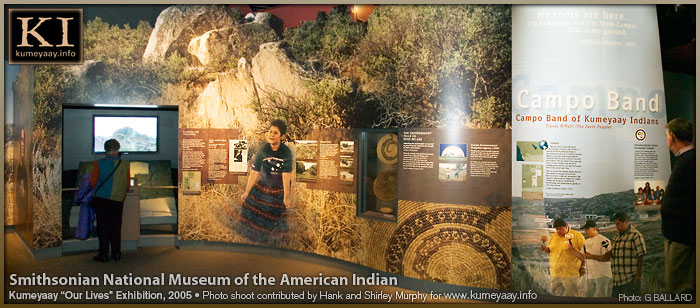


 Tribal information academically presented by FOUR DIRECTIONS INSTITUTE www.fourdir.com