|
 |
|
|
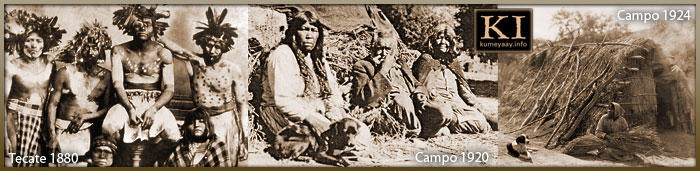
KUMEYAAY CULTUREKumeyaay Tribal Culture developed as an Aboriginal tribal society in cultural isolation over TIME IMMEMORIAL. Anthropologists have scientifically traced the earliest inhabitants of what is now called San Diego to the San Dieguito Paleo-Indians back to about 10,000 B.C. The Southern Diegueño-Kamia (Ipai-Tipai) emerged from this group at about 3,000 B.C. These prehistoric tribesmen are the direct ancestors of some Kumeyaay Indigenous tribal members presently living in the greater San Diego area at the turn of the 21st century. European "DISCOVERY" 1542:
At the time of "discovery" (1542), anthropologists speculate the Kumeyaay were living in the Late Prehistoric Period (the Stone Age) with no use of metal or cloths. THE KUMEYAAY WAY:
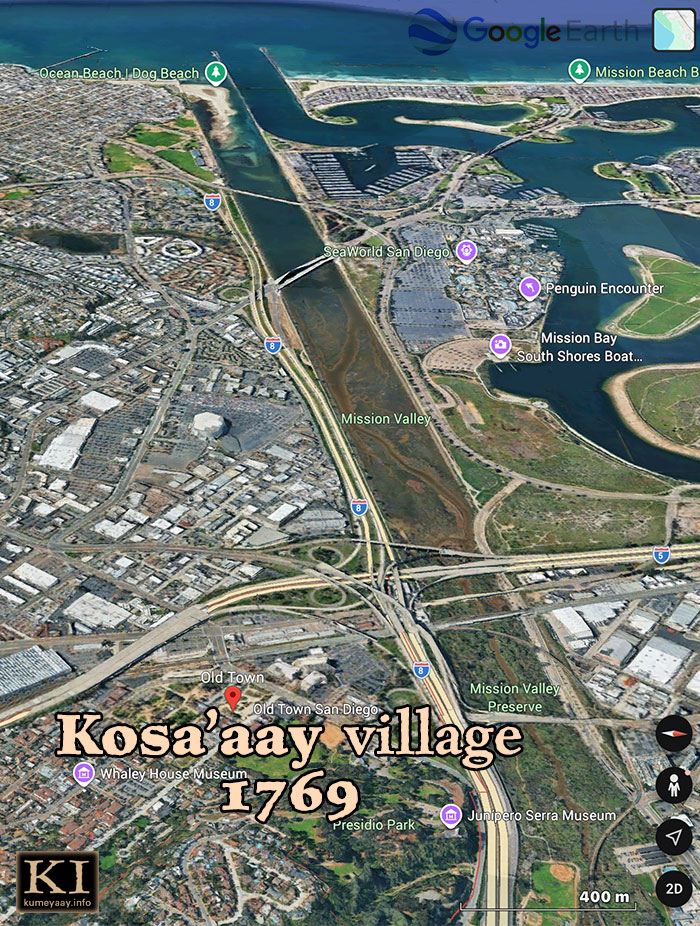
Includes Subsistence, Housing and Technology, Settlements and the Seasonal Round, Kumeyaay Agriculture, Social Organization, Trade, Spiritual Life.... MORE. Colonial "INVASION" 1760s: "Invasion" (1769) -- the ancient Kosa'aay Kumeyaay village became the mid 18th century gateway to the Colonial invasion of West Coast California tribal lands and marks GROUND ZERO for the California Aboriginal peoples. It is the exact spot on the map where the Spanish Empire got their foothold on the original California Indian ancestral homelands. This area is known today as Old Town San Diego and it thrives in the 21st century as a popular tourist spot celebrating early Colonial history in San Diego:
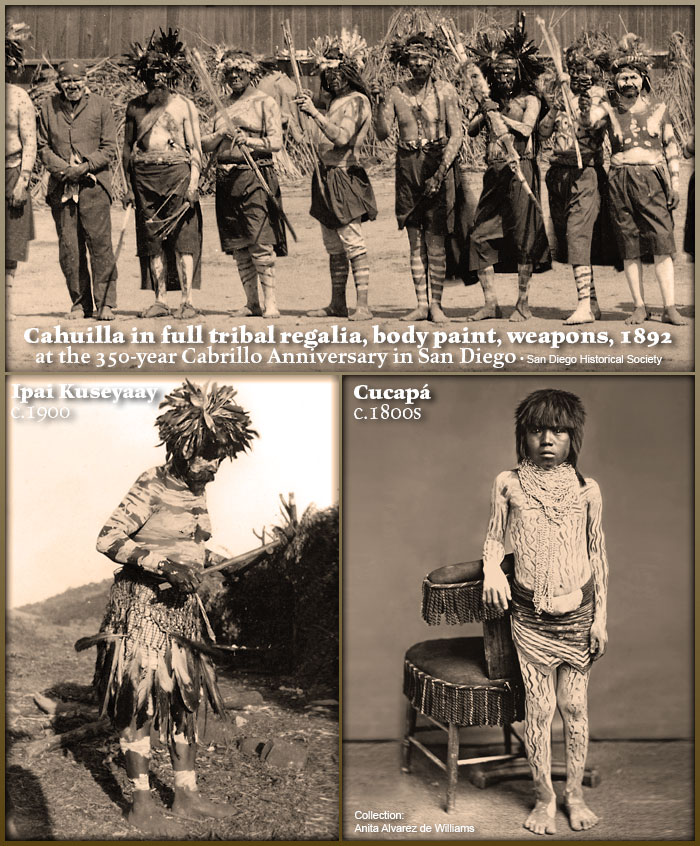
Nadir view of San Diego sea and land terrain pinpointing historic Cosoy Kosaaay village. THE WAY BACK: The following 3-in-1 montage suggests how the California Aboriginals likely appeared to Portuguese explorer Juan Rodriguez Cabrillo upon "Discovery" 1542. And to Spanish explorer Gaspar de Portolà ("Invasion" 1776) -- the later historically footnoted as the celebrated founder of San Diego. I can imagine this is how the 16th and 18th century tribesmen appeared on the shorelines and villages of "Discovery" 1542, and "Invasion" (1760s):
The Cahuilla tribe (top image) is one of the four Indigenous tribes to the San Diego region. The Cucapá tribe (lower right) is one of two Yuman tribes categorized within the so-called Hokan Delta-California language group. The closely-related Kumeyaay Ipai tribe is the only other tribe on Earth with that linguistic distinction.
CONQUERED (maybe, but never defeated): In the 1770s -- when the Spanish conquistadors went to war with the Kumeyaay over control of their prime ancestral homelands, resources and freedom: It was Spanish steel swords, body armor, cannons and musket fire against primitive sticks and stones.
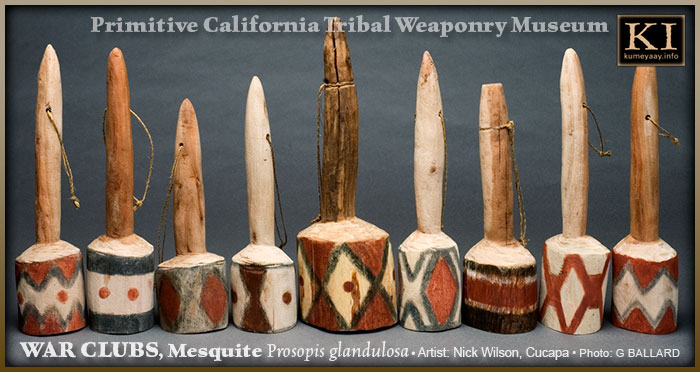
Eighteenth century tribal weaponry pictures period-style war clubs carved from local mesquite and hand painted with local Yuman tribal motifs using traditional red paint or red dye, cochineal (Dactylopius coccus). Respected Aboriginal ethnographic artist Nick Wilson CUCAPA handcrafted these unique museum-grade mesquite primitive war clubs around 2004 for museums, collectors and sale across the US-Mexico Border.
Andres Albanes, Kumeyaay-PaiPai Indian archer and traditional ethnographic bow and arrow maker, Santa Catarina Indigenous community, Baja California, Mexico, 1990s (photo Paul D. Campbell). It's not that the Kumeyaay were not fierce warriors -- the Spaniards had dug into the territory with garrisons of trained military soldiers and superior weaponry to defeat the tribesmen and win the battle for control over their prime coastal lands. In 1779 Lt. Colonel Pedro Fages summed up the Kumeyaay attitudes as follows:
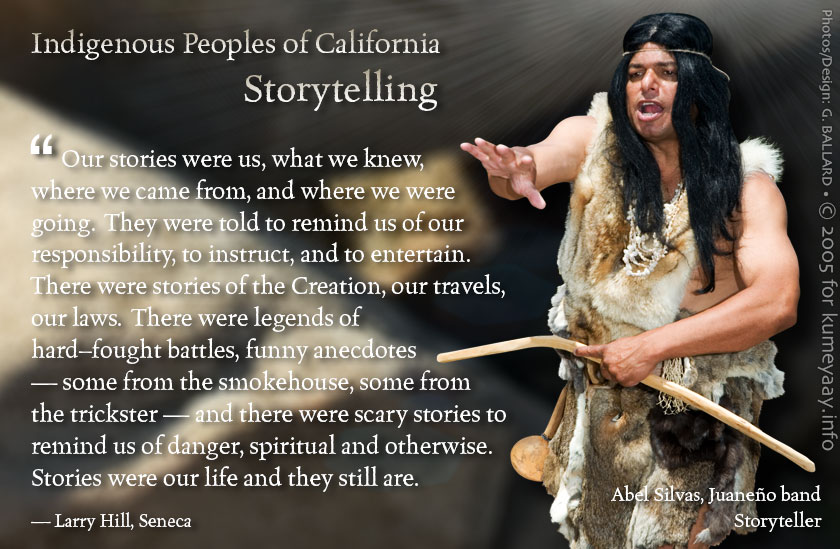
TRIBAL CLAN RULE: In small primitive tribal society, Tribal Rule is deeply ingrained into family clan culture, including today's Kumeyaay culture. Kumeyaay bands or clans up to the 20th century traditionally supported as many as 15 families. The chief (or clan leader) has final say and everyone follows in support regardless. This is how tribal family clans evolved and survived over hundreds of generations. RECORDING THE HISTORY AND CULTURE: Traditionally, Kumeyaay history and culture were passed down orally across generations through Singing and Storytelling, and recorded in painted pictographs and petroglyphs and granite sculptures. These vessels -- passed generation to generation -- are how the Kumeyaay recorded and preserved their culture and history for future generations.
The Yoni granite sculpture background in this composited graphic was photographed at Indian Hill, Anza Borrego Desert State Park in 2004 -- notice the dark aged paint, it must have been all painted up in original celebrated form. The rare Polychrome olla was found in the late 1900s in western Imperial County. The Petroglyph rock was photographed by Kelly Washington in 2004 at Vii Kwame, a sacred mountain for many of the Yuman tribes. European Colonialism conflicted sharply with 18th century Kumeyaay perspective. Spanish explorers, conquistadors and missionaries of the period were focused centrally on plundering the rumored Seven Cities of Gold (Kumeyaay gold). To believe their conquest was about anything else would be naive. The Spanish Empire used the same invasion model 250 years earlier when they destroyed the Aztec Civilization for its gold in 1519. The United States government still maintains its legal standing over American tribal lands in the 21st century under the Doctrine of Christian Discovery and Manifest Destiny.
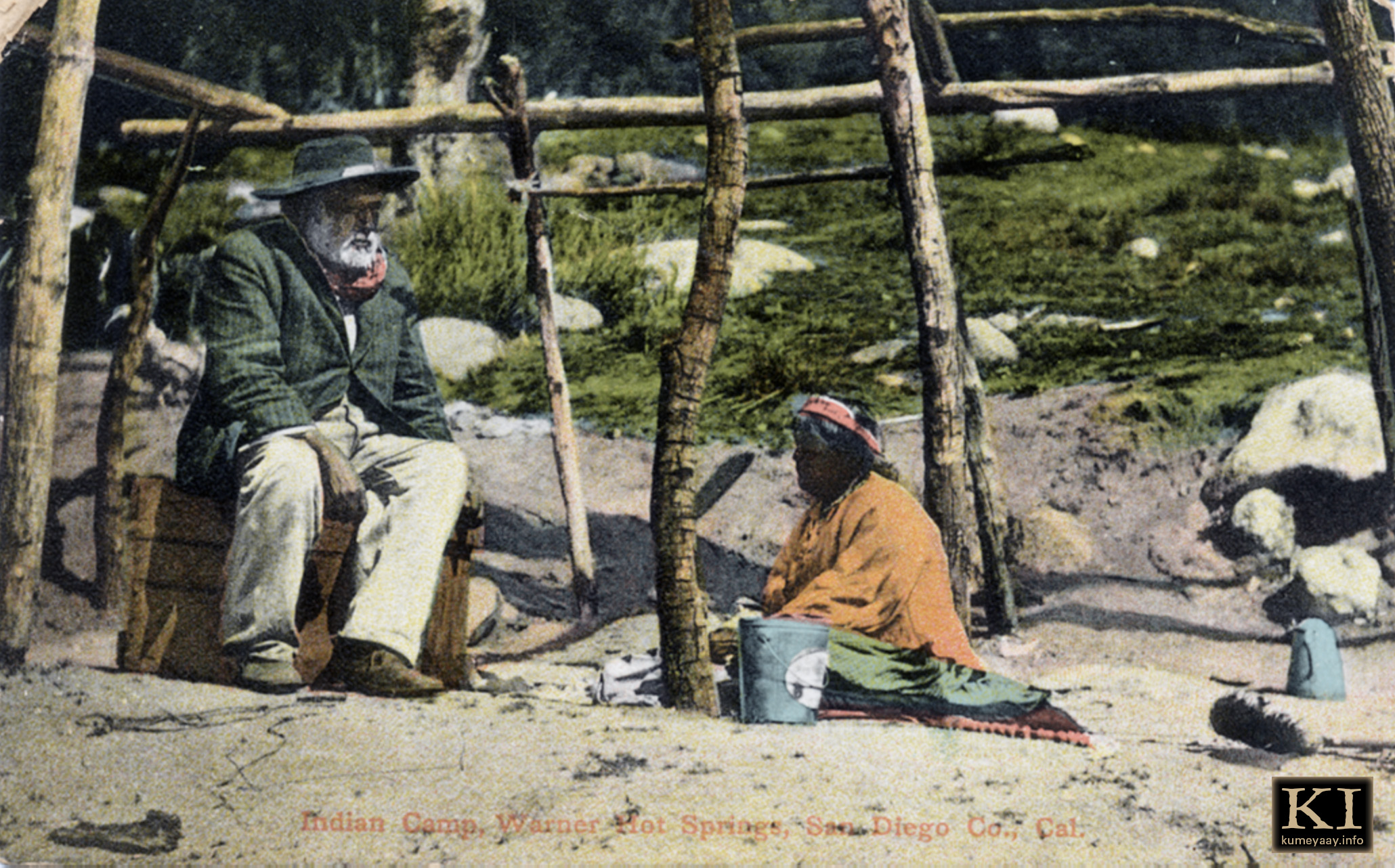
Indian Camp, Warner Springs, San Diego County, tourist postcard c.1900 -- authentic period photograph shows an elderly Aboriginal couple seeking refuge among the rocks, languishing in grinding abject generational poverty. But the Kumeyaay people survived Colonial invasion (1760s), belligerent asymmetric warfare for their prime ancestral homelands and resources, and 150-200 years of subsequent genocide, neglect, and grinding abject generational poverty to the turn of the 21st century. Tribal Sovereignity in America Today: The Constitution of the United States, U.S. Supreme Court rulings, state and federal laws -- as well as historical Treaties with the U.S. government -- all support the federally-recognized Native American tribes' legal rights to self-governance and certain limited forms of national SOVEREIGNTY.... Federally-recognized Indian reservations today are sovereign land and governed by the respective tribal bands. Police matters are generally handled by U.S. government agencies like the FBI. Local PD, sheriffs, marshals, prosecutors, judges, state governments tread lightly on tribal lands. TRIBAL GAMING IN SAN DIEGO COUNTY: The INDIAN GAMING REGULATORY ACT IGRA 1988 became law of the land and legalized tribal gaming on sovereign American Indian reservation lands across the United States. This 20th century federal legislation ushered in an era of GREAT CHANGE for the Native American peoples and brought quick relief for some American Indian bands, including substantial wealth and political clout to pursue restoration of their nearly-lost cultures, lands and societal resources. Kumeyaay bands currently own and operate six of the nine Indian casinos in the County of San Diego. Tribal gaming revenue in the U.S. is big business. It topped $46 billion in fiscal year 2025 for the 246 Native American bands operating legal gaming operations (National Indian Gaming Commission statistics). CULTURAL RENAISSANCE Aided with substantial newfound financial wealth through tribal gaming revenue, the bands began rebuilding basic blocks of their lost culture through the rebirth and preservation their languages and stories -- the traditional vessels their ancestors used to preserve their Kumeyaay culture and heritage across generations.
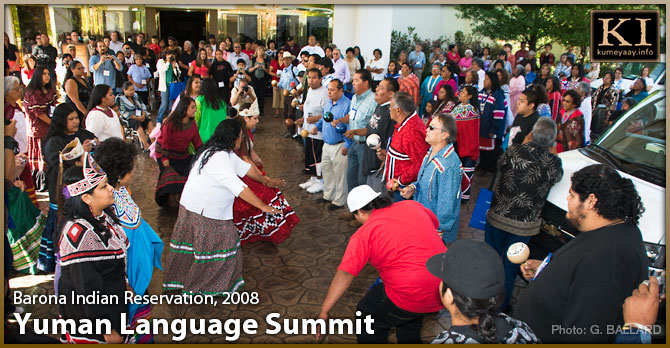
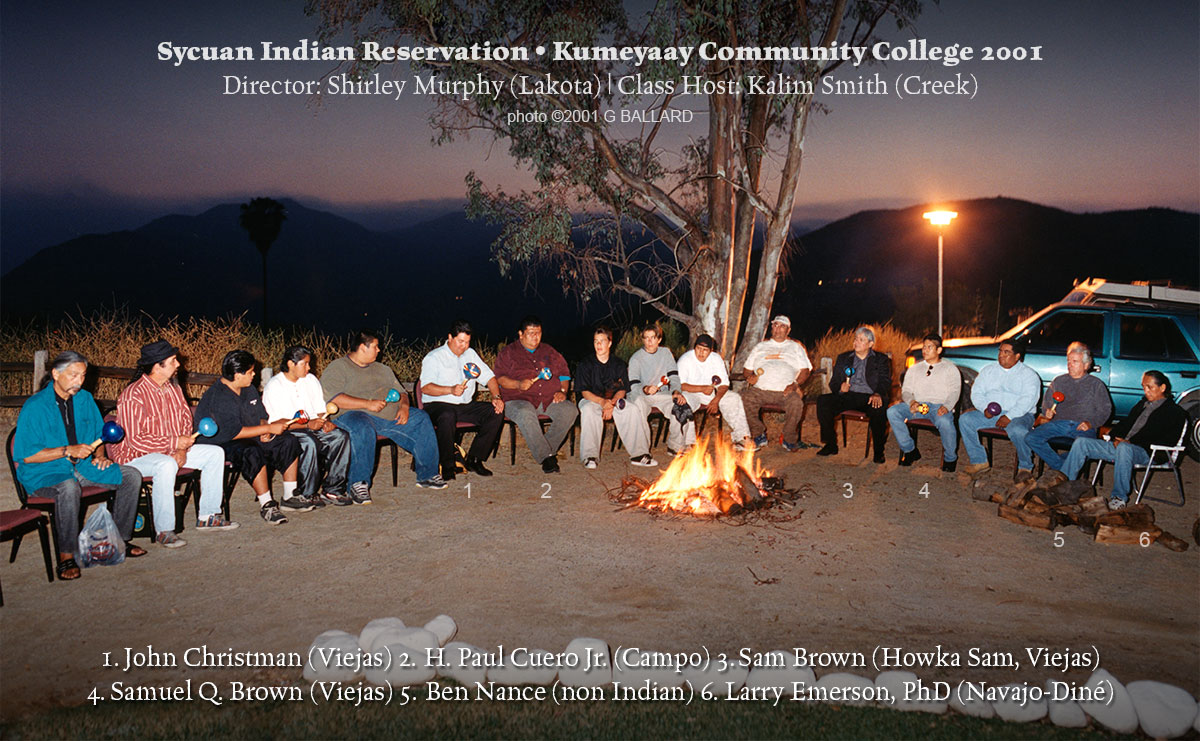
Yuman language singers (above), Sycuan Indian Reservation, Kumeyaay Community College students and mentors, are pictured atop a mountain in this historic Kumeyaay photograph around a burning campfire learning and singing timeless traditional "bird songs" of their Indigenous Yuman ancestors.
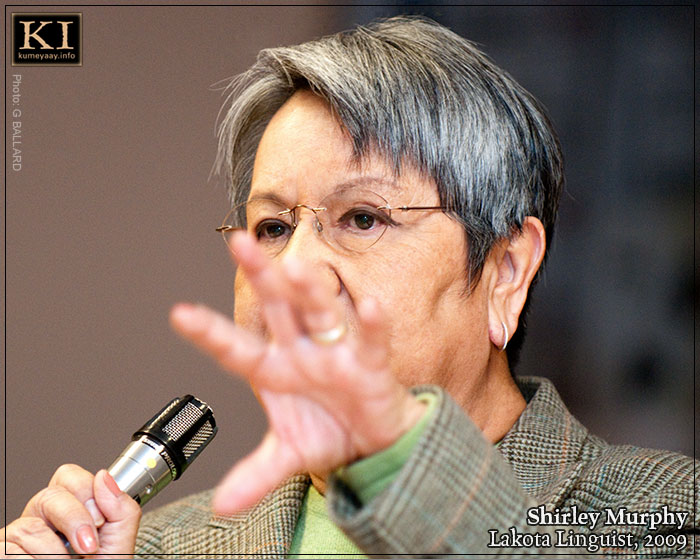
Shirley Murphy (Lakota) was instrumental in the turn-of-the-century Indigenous cultural renaissance in the County of San Diego region by establishing accredited language and cultural programs on the Sycuan Indian Reservation, Kumeyaay Community College. What I witnessed as a tribal photojournalist across some 35 years of service to the California Indian peoples -- the Mexican and American tribal communities -- both regions exhibit strong Indigenous social blood ties and tendencies for sharing. This is probably from their stronger tribal roots that my white race lost centuries ago through technology, insatiable greed, corruption and lust for power. Kumiai de México:
The Baja Calif. Mexico bands seem to have more of their tribal "culture" intact -- Native language speakers, ethnographic artists, and what I would consider a simpler "Indigenous" lifestyle (more self-sufficient, off-the-land lifestyle more in harmony with nature). Kumeyaay of the United States:
While the Alta Calif. American bands live more contemporary "American" lifestyles with successful businesses, nice housing, technology, health care, education (opportunities), leisure time. However, this upper-class lifestyle is a post-casino-era phenomenon for the Kumeyaay (1990s). Some of the elder Kumeyaay Indians I met spoke briefly in my presence about their childhood poverty experiences, the racism they experienced for being Indian, and government "cheese trucks" that delivered unhealthy food commodities on the reservation under the USDA Food Distribution Program on Indian Reservations FDPIR (1950s-1970s). Though the great majority of Kumeyaay people I met showed positive outlooks for the future and good hearts -- like you see in many extended family groups -- the occasional goofball and criminal.
KUMEYAAY CULTURAL Resources Here are some recommended study and research articles to learn about Kumeyaay culture, past and present.
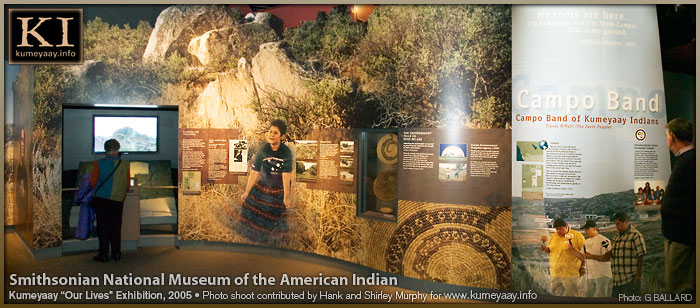
The Campo Band of Mission Indians (a sovereign Kumeyaay nation) shared their Kumeyaay culture in this interesting display at the Smithsonian National Museum of the American Indian, 2005.
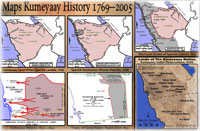
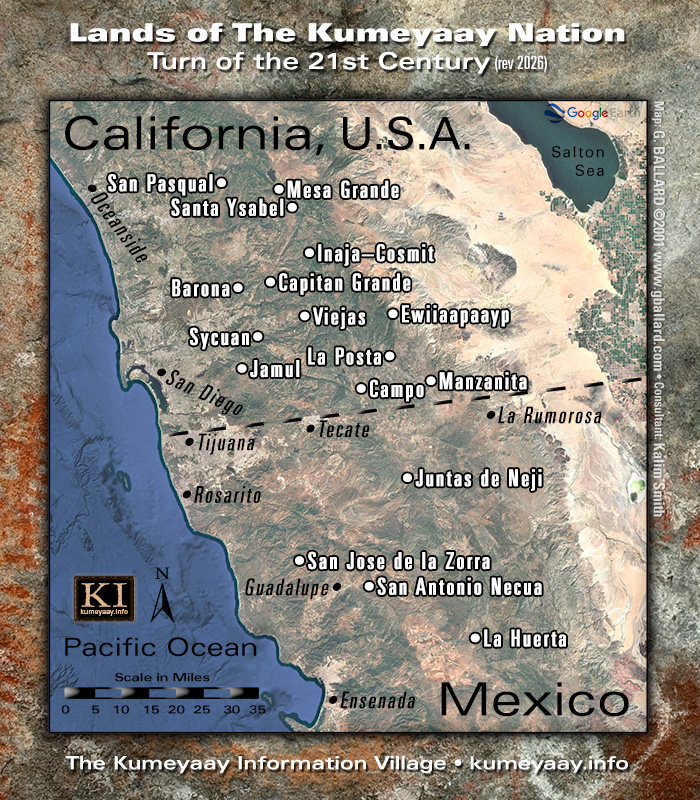
KUMEYAAY MAPS PROJECT
Historic present-day area of Kosa'aay pictured in 2026, now known as Old Town San Diego, GROUND ZERO for the California tribes.
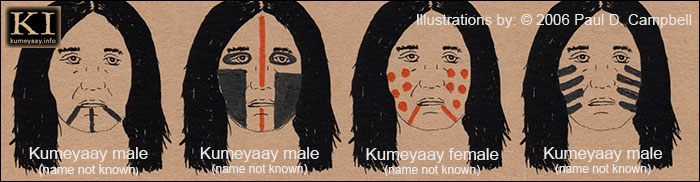
Kumeyaay tribal body, face painting and tattooing were practiced by tribal members and the colors and designs used had special meanings of significance to the individuals and social groups in the area. Early tribal members got their colors from Nature in natural pigments like yellow and red ochres, white clay, red cochineal (Dactylopius coccus). They used these materials for cave drawings and decorative art on weapons, including face and body decoration. THE KUMEYAAY MILLENNIUM:
KUMIAI (DIEGUENO TIPAI KUMEYAAY):
accessgenealogy.com YUMAN INDIAN TRIBE HISTORY
MARICOPA INDIAN TRIBE HISTORY
COCOPA INDIAN TRIBE HISTORY
COCHIMI INDIAN TRIBE HISTORY
CALIFORNIA INDIAN TRIBE HISTORY
|
|||||
KUMEYAAY Cultural Resources:
CULTURAL Movies: |
|||||
| Terms of Use • Privacy Statement • Site Map Kumeyaay Indians Home • About Us • Mission Statement • Press Kit • Contact Us |
|||||

 This ethnographic overview focuses on the Kumeyaay of southern San Diego County. It is based upon the detailed descriptions and research findings of several important ethnohistorical and ethnographic studies.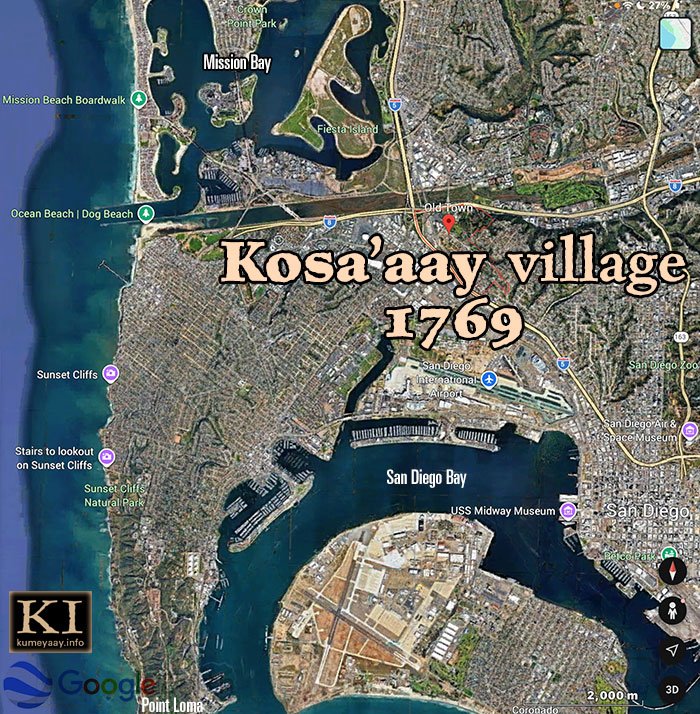


 Indeed this tribe, which among those discovered is the most numerous, is also the most restless, stubborn, haughty, warlike, and hostile toward us, absolutely opposed to all rational subjection and full of the spirit of independence.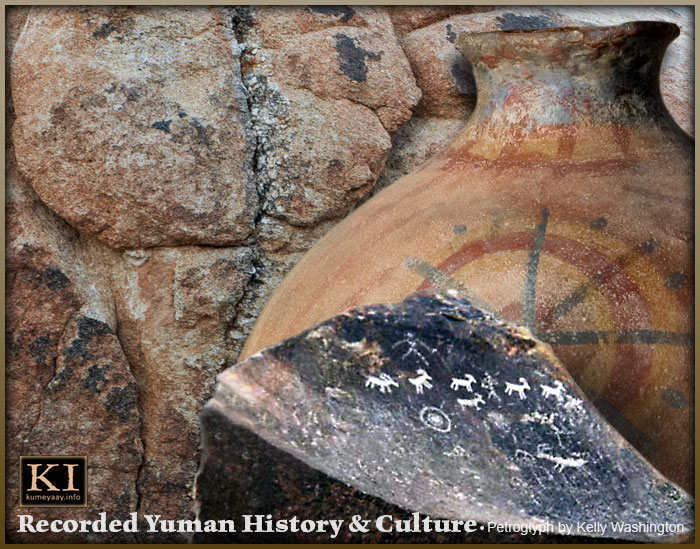



 (site deleted)